
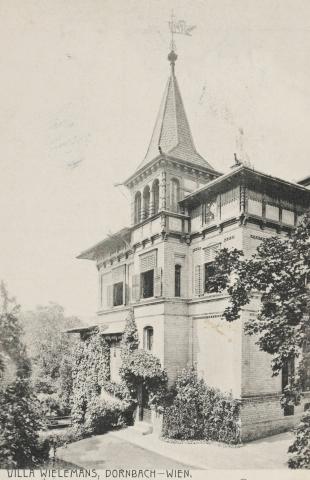
Alois Bauer, a partner in the curtain and carpet factory Leopold Selmeczi & Son in Wiener Neustadt, with a branch office at Fischerstiege 9, in Vienna’s 1st district, had lived, since 1921, with his wife Ella, née Lederer, in a Renaissance-style villa at Zwerngasse 14–16 in Vienna-Dornbach, built around 1880/1881 by architect Alexander Wielemans, of which he owned a 13/14 share. Their children Georg (1922) and Franziska (1925) were born there. Immediately after the annexation of Austria to the German Reich, the family was, according to reports, “forcibly evicted from the house by the Gestapo” on 13 March 1938, and found refuge with Alice Husser, Ella Bauer’s sister, at Brandstätte 3, in Vienna’s 1st district, Innere Stadt. In his declaration of assets dated 14 July 1938, Alois Bauer stated that, in addition to the villa, he owned one-third of another property in the 21st district, a house in Plank, Lower Austria, as well as paintings by Olga Wiesinger-Florian, Eduard Lichtenfels and Hans Burkhard. He also listed valuable furnishings, including a two-door oak cabinet, a mirror and a chandelier from the Meissen Porcelain Manufactory. These items were subject to the “Führer’s Reserve” enacted in June 1938 and, following a seizure order issued by the Gestapo on 6 December 1938, were deposited on 13 December 1938, at the central depot in the Neue Burg. The Innere Stadt-Ost Tax Office demanded that Alois Bauer pay a Reich emigration tax of RM 150,000, which was due by 2 September 1938. Shortly before that, in July 1938, the family managed to flee to Nachod in Czechoslovakia, the place of origin of Ella Bauer’s family. In 1939, the couple went their separate ways there. On 30 April 1939, the Vienna Gestapo headquarters had the seizure of Alois Bauer’s share of the property entered in the land registry. In 1940, the municipal administration of the Reichsgau Vienna was registered as the owner. By 1944, after several transactions, the villa on Zwerngasse came entirely into the possession of the National Socialist People’s Welfare (NSV), which used it as a children’s home until the end of the Nazi regime. On 4 September 1944, the furnishings—including the aforementioned mirror and chandelier—were handed over for sale by the Innere Stadt-Ost Tax Office to the Dorotheum, to cover debts. According to an expert opinion issued by the Institute for Monument Preservation in 1944, the objects, which had previously been subject to the“Führer’s Reserve”, had no museum value.
According to a 1948 ruling by the Regional Court for Civil Matters, Alois Bauer presumably died in a camp in the Generalgouvernement in 1941. Ella, Georg and Franziska Bauer were deported to Theresienstadt on 17 December 1942, transferred from there to Auschwitz on 23 January 1943 and murdered. Close relatives of the Bauer family were also murdered in various concentration camps: Ella Bauer’s brother Artur Lederer (1898–1942, Auschwitz), his wife Marie, née Guttmann (1901–1943, Auschwitz) and Alois Bauer’s sister, Anna (1888–1942, Maly Trostinec) along with her husband Siegfried Diskant (1887–date of death unknown, Generalgouvernement) and her son Hans Diskant (1922–1942, Auschwitz).
As early as August 1946, Alfred Husser, Alois Bauer’s brother-in-law, began searching specifically for items from the Meissen Porcelain Manufactory. According to information provided in August 1946 by August Freis, the auctioneer at the Dorotheum, these items were auctioned off under consignment number 38,898 to the Dr. Kriehuber Gallery at Stallburggasse 2, in Vienna’s 1st district on 29 September 1944; however, the gallery denied this. In accordance with the provisions of the Second Restitution Act, the Dornbach Villa was returned to the heirs of Alois, Alice, Georg and Franziska Bauer in 1949. Nothing is known about the whereabouts of the paintings and furniture.