
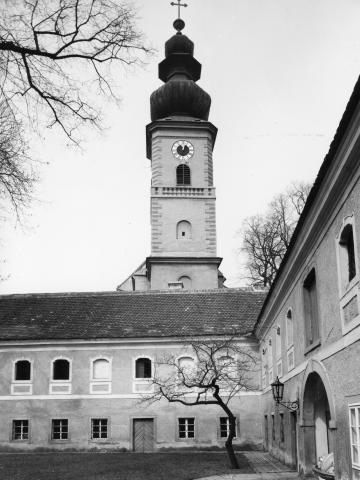
In late January 1941, Herbert Seiberl informed Leopold Pindur, the senior government official for cultural affairs in the administrative group of the ‘Niederdonau Gau’, that he felt compelled to take “precautions for the necessary removal of works of art” from the Benedictine Schottenstift in Vienna. Based on the so-called ‘Reichsleistungsgesetz’ (Reich Contribution Law) of 1 September 1939 (RGBl. I p. 1645), Pindur allocated the rooms of the Gaweinstal rectory to the monument preservation authority for the storage of works of art. Seiberl had already had his eye on the rectory when he mentioned the need for renovation to Pindur in 1940, as it offered space for a large number of artworks and was located away from the railway lines, which were targets of Allied air raids. On 24 February 1941, 157 paintings and two Biedermeier tables were moved from the Schottenstift gallery to the Gaweinstal rectory. In May 1941, Seiberl submitted an application for a grant to restore the stucco ceiling in the rectory to the Reich Minister for Ecclesiastical Affairs in Berlin, noting that numerous skilled workers could be deployed immediately since they were unemployed. In 1942, 112 paintings were restored; these were transferred from the salvage depot in the rectory on 29 April 1942 (21 paintings) and on 9 November 1942 (91 paintings) to the restoration workshop of the Institute for Monument Preservation on Rennweg in Vienna’s third district. At the same time, in November 1942, 20 of the paintings that had since been restored were returned to the Gaweinstal rectory. The return transport of the paintings to Vienna took place as early as January 1945. For temporary storage, they were moved from Gaweinstal to the premises of the Bodenkreditanstalt at Teinfaltstraße 8, in Vienna’s first district, which had been rented by the Institute for Monument Preservation, and were handed over to the Schottenstift on 8 May 1945. However, the lists compiled for this purpose revealed that some works of art were missing. The items had been entrusted to the restoration workshop of the Institute for Monument Preservation by the Schottenstift, the Herzogenburg Abbey, and private owners such as Ferdinand Piatti and Anton Lanckoronski in 1944. The monument preservation authority blamed the loss on Red Army soldiers who had occupied the Institute’s offices, as well as on Italian prisoners of war. In January 1946, the State Monuments Authority informed the owners about the report filed regarding the lost works of art and suggested a review. Josef Zykan, an official with the Federal Monuments Authority (BDA), which had been reestablished in March 1946, noted during his inspection of the rectory on 25 April 1946, that twelve paintings could not be located. Ten restored paintings as well as 24 art objects, including mirrors and sculptures, were subsequently delivered to the Abbey, while 35 damaged paintings were transferred to the BDA’s official workshops for restoration. On 25 July 1946, the Gaweinstal storage facility was dissolved.
In 1956, the Chamber Office of the Schottenstift commissioned Hans Herbst, treasurer during the Nazi era and chief expert of the Dorotheum’s art department, to track down the lost paintings. He was able to correct several errors in the earlier inventories of the Schottenstift and the BDA. For example, he clarified that the Dutch painting “Man with a Book” had not been lost, but was in the official workshops for restoration under a different title, “Peasants in the Tavern”. On 26 February 1957, the Schotten-Benedictine Abbey reported 36 paintings to the Provincial Tax Office (Finanzlandesdirektion = FLD) in order to receive compensation in accordance with the government bill on the Besatzungsschadengesetz (Occupation Damages Act (§ 6 para. 9)). However, on 9 March 1957, the FLD rejected the BDA’s recommendation to grant compensation, as compensation for lost works of art was not provided for at that time.