
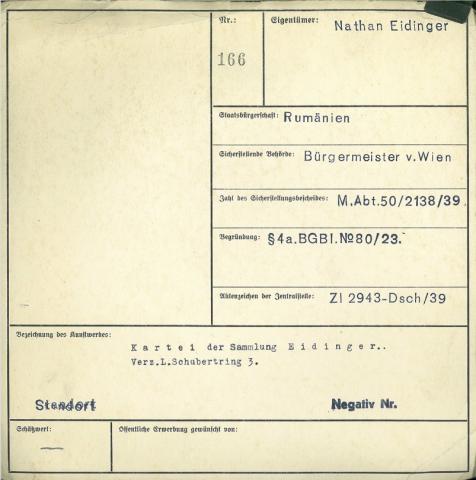
The merchant and art collector Nathan Eidinger owned sugar factories in Romania and was a partner in the Vienna-based Cottage Sanatoriums AG (Cottage Health Resort Public Limited Company). He and his wife Bertha Eidinger, née Fischler, were Romanian citizens; the couple had three children: Sabine, Dora and Alfred. The family practised the Jewish faith and lived the Vienna’s 1st district at Schubertring 3 until 1938. Due to a loan and the resulting settlement in 1934, Nathan Eidinger had to pay half-yearly instalments of 17,000 schillings to the heirs of the lender, Ottokar Czernin, until 1939. In June 1937, Nathan Eidinger pledged his shares in the sanatorium to the Fried & Thiemann Bank.
After Austria's annexation to the Nazi German Reich in March 1938, the family fled to Switzerland. Nathan Eidinger therefore stopped paying the final instalments to Ottokar Czernin's heirs, who then claimed Nathan Eidinger's art collection, which had been secured by the Central Monument Protection Office in 1939, and filed a lawsuit at the Vienna provincial court for civil law matters. In 1940, the court granted the plaintiffs access to the 166-piece Eidinger collection. In 1942, the State Arts and Crafts Museum in Vienna (now the MAK) acquired 37 items from the Eidinger collection from Theobald and Peter Czernin, who were then considered the owners. Further glassware and porcelain were sold to the Joanneum in Graz (17 items), the Ferdinandeum in Innsbruck (12 items) and the Viennese art dealer Marianne Scharmitzer (10 items). One painting was taken by Gunther Spitzy, a representative of Ottokar Czernin's lawyer representing the heirs. The whereabouts of the remaining objects are unknown.
After their escape, the Eidinger family lived in Zürich, Evian, Vichy and Bucharest, among other places. Their son Alfred Eidinger, a medical student at the University of Vienna, fled to Nice, joined the Resistance, was betrayed, sentenced to death and executed in 1943. Nathan Eidinger died in Bucharest in May 1945. In 1953, Bertha and Dora Eidinger, who had remained in Switzerland, and Eidinger’s daughter Sabine, who was living in Israel, claimed the expropriated art objects under the Third Restitution Act. The Restitution Commission at the Vienna provincial court for civil law matters ruled that the Austrian Museum of Applied Arts had to return the objects acquired in 1942 and that the heirs had to pay 11,572 schillings to the Republic of Austria as compensation for the loan debt paid by the state. After settlement negotiations, the MAK acquired 12 objects for 15,200 schillings, of which 3,628 schillings remained for the heirs after deduction of the claim by the Republic of Austria. The Joanneum and the Ferdinandeum also reached agreements with the heirs of Nathan Eidinger. In autumn 1953, a total of 50 items from the Eidinger collection were restituted from the three museums in Vienna, Graz and Innsbruck, for which the Federal Monuments Authority (Bundesdenkmalamt = BDA) waived an export ban. The detailed card index (item 166) that Eidinger had created for his collection remained with the BDA. Eidinger's daughter Sabine died in Tel Aviv in 1959, Bertha Eidinger in Lucerne in 1964 and Dora Eidinger in Zurich in 1990.
On 3 July 2014, the Art Restitution Advisory Board recommended, on the basis of the Federal Art Restitution Act, the restitution of the twelve objects remaining at the MAK following their export in 1953 (10 inventory numbers) and the card index stored in the BDA archive to the legal successors of Nathan Eidinger, on condition that they reimburse the Republic for the monetary compensation received in 1953. In March 2025, following the identification of the heirs, the objects from the MAK and BDA were actually returned. Restitutions from the Ferdinandeum in Innsbruck and the Joanneum in Graz are in preparation.
Based on research by Leonhard Weidinger