
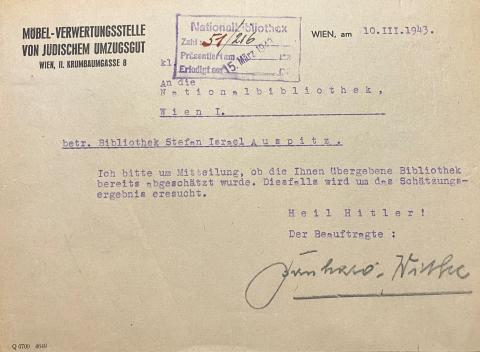
With the start of the large-scale deportations from Vienna in April 1941, the number of abandoned apartments reached such proportions that the task of clearing them and disposing of the contents exceeded the capacity of the Jewish Community (IKG), which had been forced by the Nazi authorities to cooperate. The head of the Gestapo Office for the Disposal of the Property of Jewish Emigrants (Vugesta), Karl Herber, refused to dispose of the belongings of Jews deported to concentration and extermination camps, which is why Karl Ebner, head of the ‘Jewish Department’ (Department II B/IV B) and, from 1942, deputy head of the Vienna Gestapo headquarters, commissioned the treasurer and carpenter Bernhard Witke to set up a separate furniture utilisation office. The headquarters of the organisation, which henceforth operated under the name “Möbelverwertungsstelle Krummbaumgasse” (Furniture Utilisation Office Krummbaumgasse), was located in a former kosher soup kitchen at Krummbaumgasse 8, in Vienna’s 2nd district, with a branch at Ferdinandstraße 25. Although the Furniture Utilisation Office had close ties to Vugesta – particularly as its bookkeeping and payroll were handled, at least in part, by the latter – it was directly subordinate to the Gestapo and bound by its instructions. Its superiors were Karl Ebner, later Hans Dörhage and Josef Schindler, all senior officials at the Gestapo headquarters in Vienna. Alongside Witke as head of the Furniture Utilisation Office, the carpenter Anton Grimm was involved in organisation and utilisation. Also involved were the appraisers Julius Fargel, Adolf Wawra and, until at least 1943, the second-hand dealer Leopold Berka, as well as unidentifiable appraisers with the surnames Kraus, Krenn, Getzinger, Salowitz, Bernhardt and Schaffran.
The powers and responsibilities granted to Witke by the Gestapo, which were constantly expanded, culminated in the Furniture Utilisation Office. It is believed to have begun its operations in the summer of 1941 and is likely to have continued them until the final deportation transport in March 1945, affecting a total of more than 40,000 people. It was the result of perfidious logistics, built upon the seamless interplay of Nazi agencies (Zentralstelle für Jüdische Auswanderung/Central Offie for Jewish Emigration, Gestapo, Nazi financial authorities) with the forced participation of the Jewish Community (Housing and Accounts Office), as well as the exploitation of Jewish forced labourers, who were also employed by the haulage and freight forwarding contractors J. Z. Dworak, Karl Neudorfer, Johann Zukal, Willi Dworak, Josef Swatosch, Maschka & Horak and others. Exact details regarding how the Furniture Utilisation Office operated are unknown, particularly as all those involved attempted to cover up the traces of their participationin the Shoah after 1945 ; evidence was destroyed, and victims and witnesses were often murdered. Only the basic procedures can be reconstructed: After the people concerned had been forced from their homes into assembly camps in the course of so-called ‘round-ups’, only to be subsequently deported in transports of around 1,000 people each to the concentration and extermination camps in the East, they were required not only to sign a ‘special power of attorney’ for the Central Office for Jewish Emigration and a “list of assets”, they also had to hand over their apartment keys, bearing their addresses, to officials of the Central Office for Jewish Emigration. These, together with lists of apartments, were then forwarded to the Furniture Utilisation Office via the Gestapo to; subsequently, Grimm took charge of the utilization of the contents of the apartments belonging to the “Polish transports” and Witke those belonging to the “Theresienstadt Jews”.
The apartments were inspected, partially inventoried, cleared by Jewish forced labourers or the Jewish Community of Vienna, and confirmations of receipt of the keys, together with “clearance certificates”, were returned to the Central Office for Jewish Emigration so that the collective apartments could subsequently be occupied by new tenants through the Housing Office of the Jewish Community of Vienna. Furnishings were sorted, valued by the appraisers and taken to the individual warehouses of the Furniture Utilisation Office. It is also known that Witke and Grimm handed over works of art to the Weinmüller Auction House, the Kärntnerstraße Auction House and the Vugesta for auction at the Dorotheum. The Furniture Utilisation Office also sold items directly to collections and museums; for example, there is documentation of the sale of part of the library belonging to Stefan Auspitz—who was deported to Theresienstadt on 9 October 1942—to the Austrian National Library.
The complete expropriation of the Jewish population for the benefit of the Nazi coffers was linked to socio-political measures and the creation of housing for ‘German compatriots’, and served to satisfy the desires of Nazi upstarts: Furnishings were handed over in exchange for ration vouchers to five categories of people; prominent Nazis and members of the Gestapo were given priority, followed by newlyweds, large families and victims ofbombings. Valuable items are said to have been sold on the first floor of the headquarters in Krummbaumgasse, whilst on the ground floor, items including suitcases belonging to deportees were put up for sale. Sales of inferior goods took place regularly at the Ottakringer and Simmeringer breweries. The Furniture Utilisation Office also supplied the deportees’ belongings to various Nazi organisations. The warehouses and stores, scattered throughout Vienna, were partly intermingled with the treasury’s depots, particularly as Witke and Berka ran their own antique shops and stocked their inventories with the looted goods. Corruption and abuse of office were the order of the day; there was little oversight, and the steady, quantitative increase in goods was a decisive factor in this. The Jewish forced labourers who were put to work clearing out flats, in warehouses and in the accounts department escaped deportation, at least temporarily. Some were under the ‘protection’ of Witke and Ebner and were used by them to bolster their reputations in post-war trials. However, after 1945, some survivors also testified about how the liquidation processes worked, gave an impression of the quantities of goods that filled the individual warehouses and described the traces left behind by the people who had been in the apartments.
After the Central Office for Jewish Emigration was dissolved in March 1943 and more than 45,000 people had been sent to their deaths, the Gestapo took sole charge of organising the deportations to Theresienstadt and Auschwitz. From then on, those Jews were deported whose protected status had lapsed, for example due to the death of an “Aryan” spouse, or who had been exposed by the Gestapo as “human U-boats” (people who lived in hiding). Witke also cleared out and sold off these flats. He is said to have appropriated clothing and two violins belonging to Berthold Storfer, who had gone into hiding and was arrested by the Gestapo in November 1943 and murdered in Auschwitz. Furthermore, the Gestapo made use of the personal effects of those who had fled, which had long since been seized or secured, including those of Imre Pirnitzer, whose furnishings Witke sold directly to the flat’s new tenants, and the collection of Julius Priester, which had been secured already in 1938; some of Priester’s artworks were published in the 1954 wanted list of the Vienna Federal Police Directorate, whilst others didn’t resurface on the art market until as late as 2020.
A “Performance Report of the Furniture Utilisation Office Krummbaumgasse” exists regarding the realisation of the movable property of 199 individuals from four deportation transports between February and April 1944. In it, Witke cited realisation proceeds of RM 188,255.90. This included, among others, the utilisation of the property of Franziska and Ernst Egger, their daughter Elisabeth Stahl, and Ernst Egger’s sister Helene Mayer. Franziska Egger died in Gestapo arrest; the other family members were taken to Theresienstadt on deportation transport 48c on 28 June 1944 and were subsequently murdered. Witke, Ebner, the food wholesaler Rudolf Schneeweiss, the director of the German Petroleum Industry Friedrich Ankershofen and other Nazi protégés, as well as Gestapo officials acquired works of art from the apartment's inventory; some were taken by the apartment's new tenant. To this day, the majority of the Egger collection has disappeared.
In 2002, the Restitution Commission of the City of Vienna decided to return a coconut cup that had belonged to Ernst Egger, which had been acquired in 1944 at an auction held by the Kärntnerstraße art auction house by what was then called the Historical Museum of the City of Vienna (now the Wien Museum). A connection with the utilisation by the Krummbaumgasse Furniture Utilisation Office is considered likely.
The exact scale of the massive redistribution of personal belongings from more than 40,000 people by the Krummbaumgasse Furniture Utilisation Office to the Viennese population can no longer be ascertained today. What happened to the movable property and expropriated belongings of the deportees that were still stored at the end of the Nazi regime in the countless depots and were discovered by investigators after 1945 has not yet been researched. Some of the people involved in the Krummbaumgasse Furniture Utilisation Office were brought to trial after the war ended. In 1948, the Vienna People’s Court sentenced Bernhard Witke to three and a half years’ imprisonment and forfeiture of assets, and Leopold Berka to three years’ imprisonment and forfeiture of assets. The proceedings against Anton Grimm, who went into hiding at the end of the war, were dismissed in 1955.